
Free written scope consultation - allowances, timeline, and change-order rules on paper before a single trade is scheduled
Delta Home Additions & ADU: The Fort Worth Owner’s Guide
If you’re reading this, you’ve likely discovered that the “Delta” brand associated with your home addition or ADU project in Fort Worth isn’t a faucet – it’s a construction specification, a materials package, or a builder reference that’s now failing in some way. We install and complete Delta-spec home additions and ADUs across Fort Worth, with typical installed project ranges from $45,000 to $130,000 for additions and $90,000 to $220,000 for full ADU construction. Most owners notice the problem when a subcontractor’s work starts separating, a Delta-referenced component fails inspection, or the original builder left the job unfinished. The fix usually starts with a site read: what’s actually wrong, what the Delta spec called for, and what’s holding now.
Key Takeaways
- Delta-spec home additions in Fort Worth run $45,000 – $130,000 depending on footprint, systems, and finish level
- ADU builds typically land between $90,000 and $220,000 based on square footage and utility work
- We work directly with Delta-spec drawings and material schedules, and we stock common Delta-spec components on the truck
- Written price before work starts, 365-Day Done Right Promise on every completed project
Which Delta Models This Applies To
Delta shows up in Fort Worth home additions and ADUs a few different ways. Some projects use Delta-branded fixtures and hardware as part of a builder’s spec package. Some reference Delta as a shorthand for a specific door hardware line, a flooring specification, or a materials schedule written into the original plans. Here’s the practical reality: if your addition or ADU was built in the last 20 years and the original spec sheet lists “Delta” on any line item, you likely have a Delta-spec component that needs to match correctly when it fails. The right move is to pull the original plans, find the actual Delta part number or specification, and match it directly. We’ve seen too many Fort Worth homeowners buy a generic replacement that’s dimensionally wrong or out of spec because they didn’t verify the exact Delta model listed in their documents. For OEM versus aftermarket: Delta-spec structural components, window assemblies, and hardware sets are worth matching OEM. Cosmetic pieces like trim, flashings, and certain fixtures can take quality aftermarket equivalents if the dimensions and ratings line up. Bradford Remodeling Co Fort Worth is an independent contractor; we’re not affiliated with Delta. We work from the original plans and the Delta spec sheet to get the right part the first time.
Styles & brands we work with







Signs Your Delta Home Additions & ADU Is Failing
- Ceiling cracking at the addition seam: Where the new structure meets the original house, differential settling causes hairline cracks that widen seasonally. This isn’t a Delta part issue; it’s a foundation or framing connection problem that needs a real fix before trim or drywall work.
- Delta-spec windows or doors binding at the frame: Fort Worth’s clay soil expands and contracts. If the original build didn’t account for movement, the openings shift and doors start sticking in summer. Re-shimming and re-flashing may solve it; ignoring it leads to water intrusion.
- ADU utility rough-in never passed inspection: If the original contractor left you with open plumbing or electrical rough-in that doesn’t pass Fort Worth code, every day it sits makes the final cost higher. We see this all the time on partially finished ADUs around the south side.
- Water staining at ceiling or soffit corners: In a home addition, the roof overlap and soffit details are where most builders cut corners. A failed overlap on a Delta-spec roof means moisture in the insulation cavity, which in Texas heat becomes a mold problem fast.
- Floor deflection or bounce in the added space: If the joists were undersized or the substrate was installed over a weak floor system, you’ll feel movement when you walk across the addition. That’s a structural signature, and it won’t fix itself.
See the difference
 Before
 After
After Before
 After
After Before
 After
AfterReplacement Cost & What’s Included
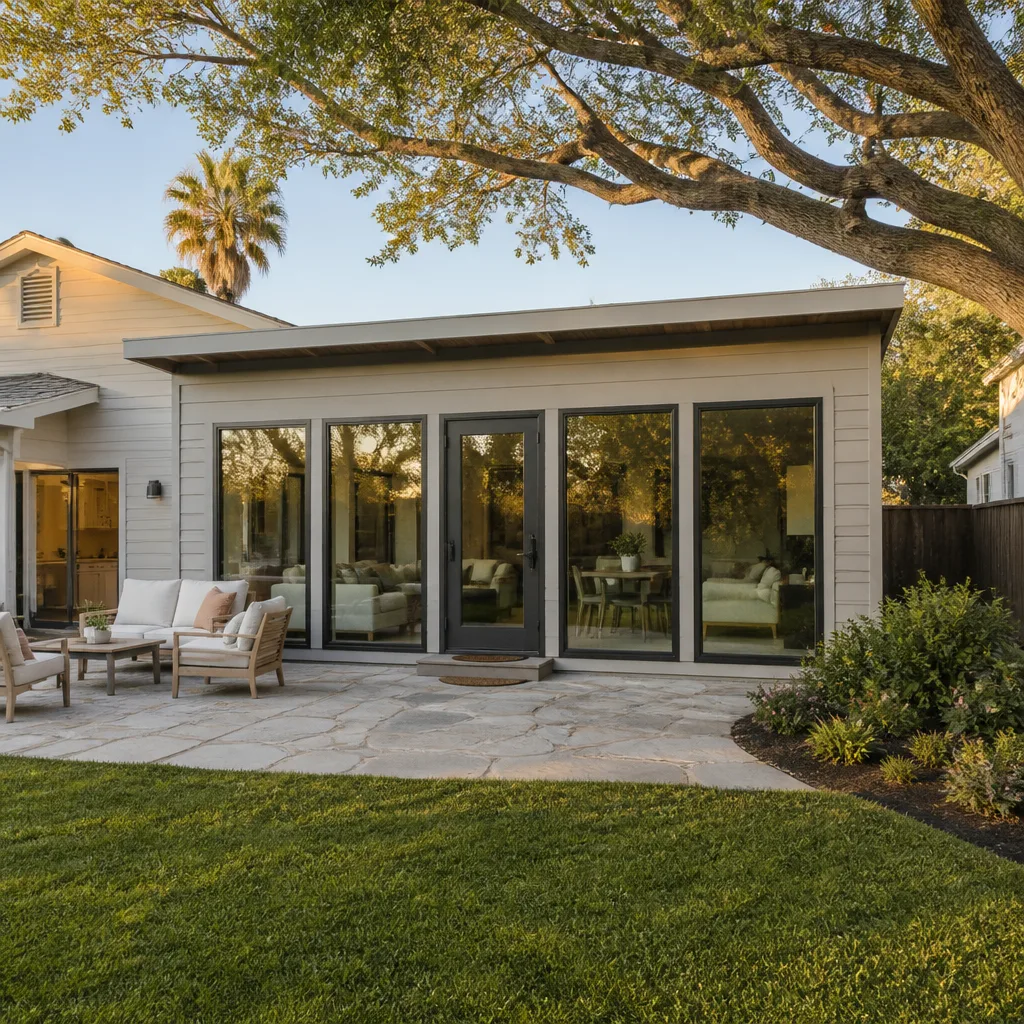
In Fort Worth, the price to make a failing home addition or ADU right depends on what you’re actually fixing. Full addition rebuilds or major corrections run $45,000 to $130,000. ADU builds run $90,000 to $220,000 depending on square footage and whether you’re dealing with a detached or attached unit. Here’s the breakdown:
| Scope | Price Range |
|---|---|
| Home addition (new, full build) | $45,000 – $130,000 |
| ADU construction | $90,000 – $220,000 |
| Garage conversion to living space | $30,000 – $80,000 |
| Kitchen remodel (within addition) | $14,000 – $45,000 |
| Bathroom remodel (within addition) | $9,000 – $28,000 |
The range drivers are structural, not cosmetic. Whether we’re correcting framing, rebuilding a roof line, or pulling new electrical service, the cost moves with load-bearing requirements, permit fees in Fort Worth, and what the Delta spec actually called for in the original plans. Every project gets a written price before any work starts. The price covers materials, labor, permits pulled, and inspections passed. No numbers move at the door.
DIY or Call Us?
Some things you can check yourself: pull the original plans, find the Delta spec references, photograph the failure, and check whether the issue is cosmetic or structural. Cosmetic cracking at drywall seams in the first year is normal; re-taping and painting is a weekend job. Structural movement, electrical or plumbing rough-in that never passed, roof leaks at the addition seam, or any load-bearing element that’s failed should be handled by a licensed contractor. Curtis Lane has spent two decades pulling permits across the Southwest, and he reads the job site before he reads the quote. When a Fort Worth homeowner calls us about a failing addition, the first hour is about understanding what the original builder actually did versus what the plans said. Most of what we fix has been failing for a while before it becomes obvious. Call (682) 204-4897 to have us come look at it.
FAQs
A properly built home addition on stable footing in Fort Worth should last the life of the house, which in Texas clay soil means 50-plus years if the foundation was done right. The weak point is usually at the integration between new and old, not the new structure itself.
Most failing additions can be repaired. It’s rare that an entire addition needs to come down. The fix is usually specific: correct the foundation connection, rebuild the roof overlap, re-flash the windows, or bring the utility rough-in up to code. We don’t tear out what doesn’t need tearing out. Call (682) 204-4897 for a straight answer on your specific situation.
Small corrections like re-flashing or drywall repair take two to four days. Structural corrections take two to six weeks depending on scope and Fort Worth permitting. Full ADU builds typically run 12 to 20 weeks from permits to final inspection.
We stock common Delta-spec hardware, flashings, window components, and trim profiles on the trucks. For anything specialized or long-lead, we order direct and work from the original spec sheet so the match is exact. If it’s an unusual Delta component, we’ll tell you the lead time before we sign anything.
Written by Curtis Lane, Owner, Bradford Remodeling Co Fort Worth at Bradford Remodeling Co Fort Worth, serving Fort Worth and nearby areas.


