
Free written scope consultation - allowances, timeline, and change-order rules on paper before a single trade is scheduled
Caesarstone Driveway & Pavers: The Fort Worth Owner’s Guide
If you’re looking for Caesarstone-compatible driveway and paver work in Fort Worth, the installed price most homeowners pay runs between $7,000 and $18,000 depending on square footage, base condition, and paver style. We stock Belgard and Unilock paver lines that pair cleanly with Caesarstone outdoor surfaces, and we can typically schedule a full tear-out and reinstall within two to three weeks of your written estimate. Most Fort Worth owners discover they need this work after a winter of freeze-thaw cycles pops pavers loose, or after a drainage issue washes out the sand base under the driveway. What looked like a cosmetic crack becomes a tripping hazard, a puddle that never dries, and a driveway that shifts under the car tires.
One thing to get straight before we go further: Bradford Remodeling Co Fort Worth is an independent contractor. We are not affiliated with Caesarstone. We install and work alongside Caesarstone surfaces on outdoor kitchens, but the driveway and paver systems we use come from Belgard and Unilock, two manufacturers whose specs are documented and whose warranties back our own written guarantee.
Which Caesarstone Models This Applies To
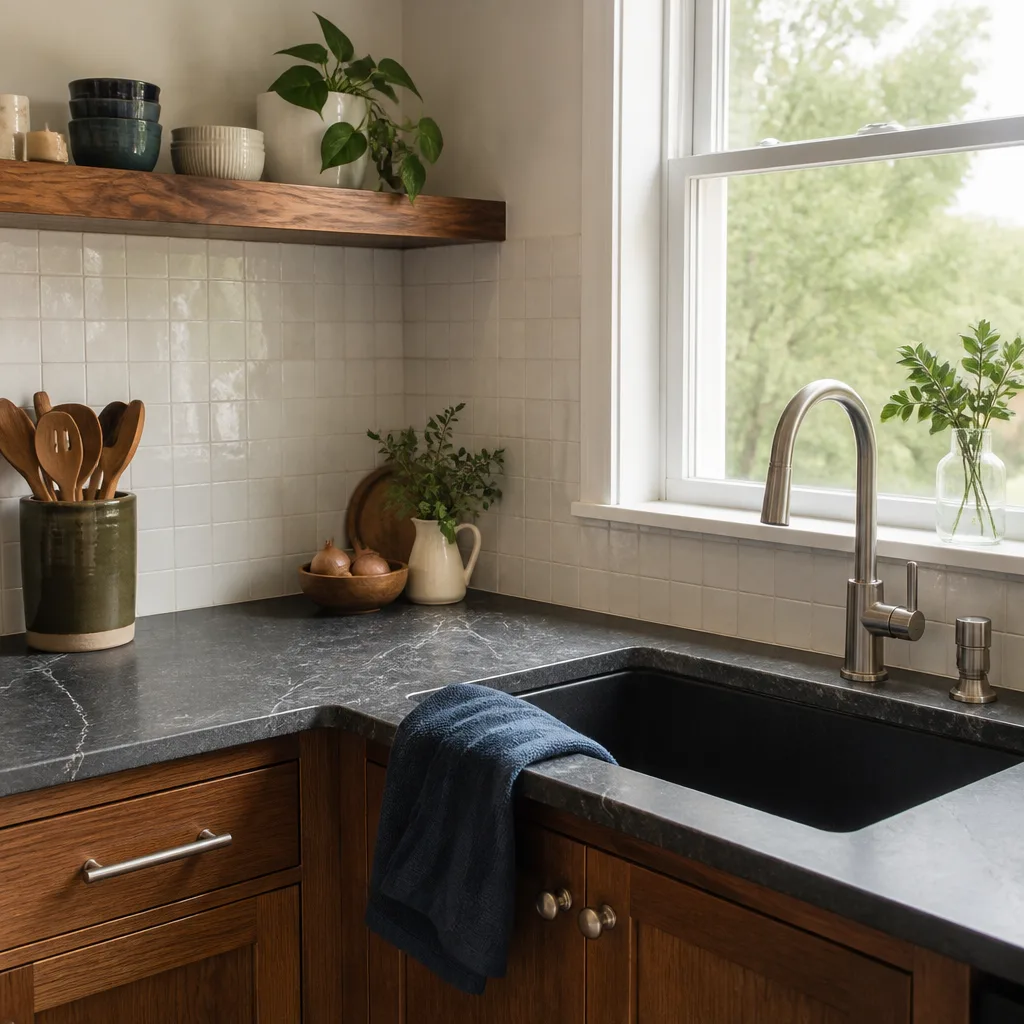
Caesarstone doesn’t manufacture pavers or driveway systems. What they make is quartz surfacing, and homeowners often extend that Caesarstone look into an outdoor kitchen, a bar top, or a seating wall that sits on or beside a paver driveway. So the real question isn’t which Caesarstone model, it’s how your existing Caesarstone surface meets the paver system around it. The compatibility point is the edge detail and the elevation. Caesarstone slabs are typically 20mm or 30mm thick (about 3/4 inch or 1 1/4 inch). When a Caesarstone outdoor counter butts against a paver walkway or sits on a paver base, the joint between them has to account for two different materials moving at different rates.
What we check on every Fort Worth job: is the Caesarstone surface on a concrete slab, a raised deck, or directly on compacted base? Has the paver edge been cut to match the Caesarstone overhang, or is there a raw gap collecting water? The OEM-versus-aftermarket decision usually applies to the paver side, not the Caesarstone side. Belgard and Unilock both make edge restraints and transition strips designed for exactly this condition. We prefer those over big-box generics because the color match and the dimensional tolerance are tighter, and because the manufacturer’s spec sheet gives us something to point to if a joint ever fails inside our warranty window.
Styles & brands we work with







Signs Your Caesarstone Driveway & Pavers Is Failing
- Pavers are popping up or rocking underfoot. That’s almost always a base problem, not a paver problem. In Fort Worth, clay soil expands and contracts with moisture. If the base wasn’t compacted in lifts, or if the edge restraint failed, the pavers lose their lock and start moving.
- Water pools in the same spot after every rain. A properly pitched paver driveway drains off the surface. Standing water means the base has settled unevenly, or the original install never had the right slope. Left alone, that water works its way under the pavers and accelerates the failure.
- Gaps are widening between the joint sand lines. Polymeric sand holds pavers together, but Fort Worth’s sun breaks it down faster than most homeowners expect. Once the sand washes out, the pavers start drifting apart, and weeds move in.
- The Caesarstone edge is chipping or the reveal looks uneven. When the paver base settles and the Caesarstone surface doesn’t, the joint between them opens up. That creates a sharp lip that catches boots, chair legs, and eventually, the edge of the quartz itself.
- You can see a visible dip or hump when you sight down the driveway. That’s a structural tell, not a cosmetic one. It means the subgrade has failed in a specific area, usually from poor compaction or a drainage pipe that wasn’t bedded correctly. No amount of sand will fix it; the pavers have to come up and the base gets rebuilt.
See the difference
 Before
 After
After Before
 After
After Before
 After
AfterReplacement Cost & What’s Included
In Fort Worth, a full paver driveway replacement runs $7,000 to $18,000 installed. That includes demolition and haul-off of the old pavers, base excavation to 8 to 10 inches, new compacted road base, a 1-inch bedding layer, the pavers themselves, edge restraint, polymeric joint sand, and final compaction. If your project includes resetting or trimming Caesarstone surfaces that meet the pavers, that adds cost depending on the linear footage and the condition of the existing quartz. We write every scope with a line-item price before work starts, so you’ll know exactly what the base work costs, what the pavers cost, and what the edge work costs. No number moves at the door. Every completed job carries our 365-Day Done Right Promise: if the work fails inside that first year, we come back and correct it at no charge.
DIY or Call Us?
A homeowner can safely do a few checks: walk the driveway and mark the spots that rock, note where water stands after a rain, and check whether the joint sand is still tight between the pavers. That tells you what you’re dealing with, and it makes the estimate conversation faster. What a homeowner shouldn’t do is try to re-lay a section of pavers over a failed base. The base is the problem, not the pavers. You’ll spend a weekend resetting stones and the first rain will undo all of it. Compaction, pitch, and edge restraint are not weekend projects. They’re also not forgiving. If you want an honest read on what’s failing and what it costs to fix, call us at (682) 204-4897. We’ll send someone out to look at the base, not just the surface.
FAQs
How long do paver driveways last in Fort Worth? A properly installed paver driveway in Fort Worth lasts 25 to 30 years on the surface, but the base underneath is what determines whether you get five years or three decades. Freeze-thaw cycles, clay soil movement, and drainage problems shorten the base life. If you’re seeing failure in year six or seven, the base was the problem from day one.
Can my existing pavers be repaired instead of replaced? In some cases, yes. If the failure is isolated to one section and the base underneath that section is still sound, we can lift the pavers, re-compact, re-level, and re-set them. But if drainage or clay movement is the root cause, a patch job buys you a year, at best. We’ll tell you which one you have before you spend a dollar. Call (682) 204-4897 for an honest assessment.
How long does a paver driveway replacement take? Most Fort Worth driveway replacements take three to five working days from demo to final compaction. Rain can extend that timeline, since base material won’t compact properly when it’s saturated. If we’re also resetting Caesarstone surfaces at the edge, add a day or two depending on the scope.
Do you stock the pavers on the truck? We stock Belgard and Unilock samples and common edge restraints on the truck so you can see your options during the estimate visit. The pavers themselves are ordered per job from the manufacturer’s Fort Worth distribution hub, which keeps your color and batch consistent. If you’re matching an existing Caesarstone outdoor surface, we’ll bring the full color deck so you’re not guessing against a two-inch photo.
If you’ve got a paver driveway that’s failing and a Caesarstone surface that meets it, get a straight number before you commit to anything. Straight scope, firm price, no surprises at final walkthrough. Call Bradford Remodeling Co Fort Worth at (682) 204-4897 to schedule your free estimate. Curtis Lane will walk the job site himself, read the base, and put the number in writing before any work is scheduled.
Written by Curtis Lane, Owner, Bradford Remodeling Co Fort Worth at Bradford Remodeling Co Fort Worth, serving Fort Worth and nearby areas.


